
Why Pigmentation Can Return After Laser Treatment and How to Reduce the Risk
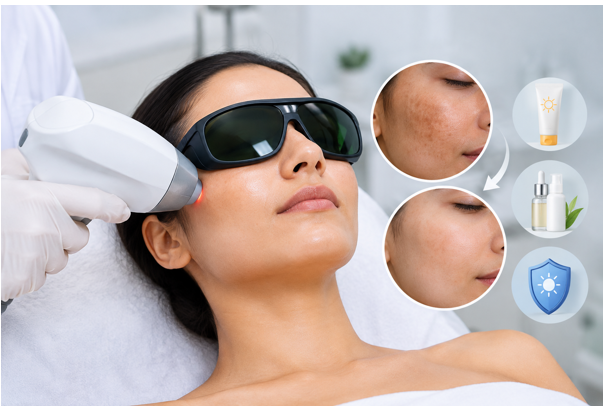
You saved up, you did the sessions, and for a few weeks your skin looked clearer than it had in years. Then the patches crept back, and in some cases came back darker than before. It feels like the money was wasted, or worse, like your skin is beyond help.
It usually isn’t either. Pigmentation returning after laser is common, it happens for reasons that are well understood, and most of those reasons are things you can influence. This article explains what’s actually going on, in plain language, so you can walk into your next appointment asking the right questions instead of hoping for the best.
First, the Thing Nobody Told You
Laser removes the pigment that’s already on your skin. It does not remove the cells that made that pigment.
Think of it like mowing a lawn. The grass is gone, and the lawn looks perfect, but the roots are untouched and still growing. Whether the grass comes back, and how fast, depends entirely on what happens after the mowing.
Those “roots” are melanocytes, the pigment-producing cells in your skin. They’re still there, still responding to sunlight, heat, and hormones exactly as they did before. Understanding that one fact explains almost everything else about recurrence.
Which of These Three Is Happening to You?
“It came back” describes three completely different situations. Your timeline usually tells you which one you’re dealing with, and they need very different responses.
1. Your original condition simply returned
If the patches faded, stayed clear for a few months, then slowly reappeared in the same places, this is the likeliest answer. Conditions like melasma are long-term and tend to relapse, the way some people’s acne or eczema does. Nothing failed. The trigger that caused the pigment in the first place- sun, heat, hormones- is still active.
2. The laser itself caused new pigmentation
This is the one most patients have never had explained, and it’s the most important to understand. If your skin looked worse a few weeks after the session, not better-then-worse, this may be what happened.
A laser works by delivering heat. Brown skin contains more melanin throughout, and melanin soaks up that heat strongly, which means the skin can end up genuinely irritated rather than just treated. And here is the cruel part: irritated brown skin responds to irritation by producing more brown pigment. That’s its natural defence mechanism.
So the darkening you’re seeing isn’t your old pigmentation returning. It’s new pigmentation, created by the treatment. Doctors call this post-inflammatory hyperpigmentation, or PIH, and it’s worth knowing that name so you can ask about it directly.
How common is it? In published medical reviews of one of the more aggressive laser types, PIH showed up in as many as 92% of patients with naturally deep skin tones. Most Indian skin falls into exactly that range. That single number is why a good dermatologist treats pigmentation in Indian skin cautiously, and why “which laser” is a medical question rather than a menu choice.
3. You stopped the follow-up care
The quietest one. The pigment faded, life got busy, the cream ran out, the sunscreen became an on-and-off thing, and over the following months the patches returned. The laser worked. What was holding the result in place stopped.
Why Indian Skin Needs Extra Care Here
More melanin means more heat absorbed.
Melanin is the target of the treatment, but in deeper skin tones it’s also spread throughout the upper layers. So the laser energy has to travel through pigment-rich skin to reach the pigment underneath, and some of it gets absorbed on the way. That’s not a flaw in your skin; it’s simply physics, and it’s exactly what an experienced doctor adjusts for.
The adjustments that matter
Good clinics change several things for deeper skin: they use gentler energy levels, longer wavelengths that reach deeper without overheating the surface, slower pulses, and cooling of the skin during treatment. You don’t need to memorise any of this. You only need to know that these adjustments exist, so that if a clinic offers you the identical protocol they’d give anyone, that’s a fair question to raise.
Getting the diagnosis right comes first.
Several different conditions produce brown patches on the face, and they look similar to the untrained eye but respond to completely different treatments. Some respond poorly to lasers no matter how well the machine is set. Any laser treatment for pigmentation should therefore start with someone establishing what your pigmentation actually is, ideally before a machine is switched on.
What Actually Reduces the Risk
Before your session
Ask what your skin type is and how that changed the settings they’ve chosen for you. A doctor who answers specifically is a good sign; vagueness here is a red flag. Ask whether you should use a preparatory cream beforehand, because starting a pigment-calming cream before treatment is known to lower the risk of the skin darkening afterwards. And be completely honest about pregnancy, hormone treatments, acne medication, and any recent sun or holiday exposure, because any of these can mean this isn’t the right week to treat.
The two weeks after (this is where results are usually lost)
Sunscreen, generously, reapplied throughout the day, plus a hat and shade. Post-laser skin is at its most reactive right now, and sun exposure in this window is the fastest way to undo the whole course. Skip steam, saunas, hot yoga, and intense workouts for as long as your doctor specifies, because heat is a trigger in its own right. And use the aftercare you were given even if your skin feels fine, since calming the irritation is precisely what stops new pigment from forming.
For the long run
Ask for a maintenance plan, and if you weren’t offered one, that’s worth asking about, because pigmentation treatment is management rather than a permanent fix. Daily sunscreen, all year, not just in summer, is the single highest-value habit here. A consultation-first approach, where your skin is properly assessed before any device is selected, is how a pigmentation treatment plan should be built.
One practical tip: photograph the area on the first of every month, same spot, same light. Slow change is nearly invisible in a daily mirror, and this is how you catch a genuine relapse early instead of six months late.
A Real-World Pattern
A woman in her late thirties came in with facial melasma and two previous laser sessions elsewhere that she felt had made her skin worse. On examination, she had both her original melasma and laser-induced darkening layered on top, a combination that’s frequently mistaken for simple treatment failure.
The plan started by not using a laser. Creams and strict sun protection came first, and laser was postponed until the irritation had fully settled. Progress was measured across months rather than weeks. She was also told plainly that melasma is controlled rather than cured, and that if the sunscreen stopped, the patches would likely return.
Questions Worth Asking Before You Book
- What exactly is my pigmentation, and how did you diagnose it?
- Which device will you use, and why is it suited to my skin tone?
- What are the chances my skin darkens afterwards, and what would you do if it did?
- How many sessions, realistically, and what’s the plan once they’re finished?
- What can’t I do for the two weeks after?
If a clinic promises permanent clearance in a fixed number of sittings, that’s a promise skin biology doesn’t support. Any skin care laser treatment for pigmentation works best when it’s presented as one part of a longer plan.
Key Takeaways
- Laser clears existing pigment but doesn’t stop the cells that make it, so recurrence is normal rather than a sign of failure.
- Three different things get called “it came back”: your original condition relapsing, new pigmentation caused by the laser, or follow-up care stopping. Your timeline tells you which.
- Deeper skin tones absorb more laser heat, so settings, device choice, and an experienced doctor matter more than the clinic’s marketing.
- Sunscreen in the weeks after treatment, and then indefinitely, protects your results more than anything else you can do.
If your pigmentation came back after a laser course, was the possibility of it ever explained to you beforehand? That conversation, or the lack of it, tells you a great deal about the care you received. Share your experience below.
